

By Sam Bennett
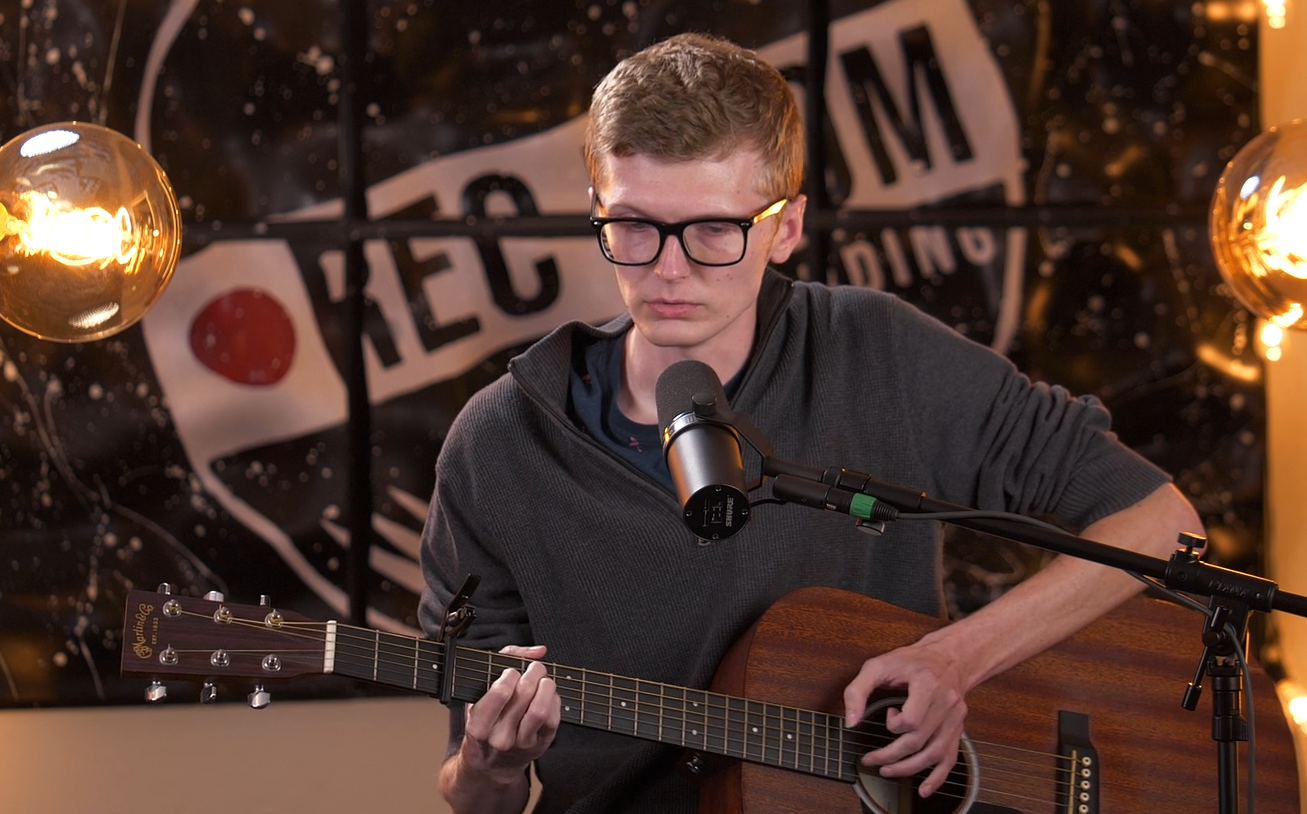
Andrew Hughes and I met on a warm Sunday afternoon in late June at Generation NA, a local non-alcoholic bottle shop in downtown Lafayette to have a conversation about his life and artistry. Andrew is the current Secretary for SAMI, the Songwriter’s Association of Mid-North Indiana. Andrew is also a singer, songwriter, and producer of five of his own albums, the most recent of which was released in November of 2024: Had Here Swung. Andrew often bears a thoughtful, attentive presence, and my hope is that this story gives us an opportunity to learn more about his identity as an artist and essential member of the SAMI community. This article will not read like a traditional interview all the way through. I will quote Andrew directly at times, but will also paraphrase some of his responses. Human minds often operate best around clear narratives, which I hope to present in what follows.
We started our conversation focusing in on how Andrew views himself as a person and artist. It wasn’t until high school that he developed a strong connection with music. Andrew associates the birth of his relationship with music to a feeling of insecurity about “not knowing enough about the world.” A “desire to know and learn things” has been a driving force in his decision-making and behavior in adult life. The world of music-making became a portal through which Andrew could continue to grow and satisfy his desire to know more about the world.
Andrew also identifies as “pretty self-sufficient and independent,” characteristics that not only shape how he approaches learning and discovery, but also how he approaches songwriting and composition. Andrew has historically written and recorded his music on his own. With five albums under his belt, the earliest of which stretches back to 2018, he has a fondness for the album as a medium because it was his customary “way of digesting music.” It is worth noting that an album can be defined as a self-sufficient, standalone musical unit. It is coincidental, at the very least, that Andrew’s self-sufficient character has labored to produce five albums that are themselves self-sufficient musical units.
Andrew arrived at his musical identity from an unorthodox direction, and this unorthodox journey has certainly influenced the uniqueness of his compositions. He went to Ball State University for English, specifically creative writing. It is not completely unheard of for creative writers to pursue songwriting, but Andrew found himself surrounded at Ball State by peers who were interested in publishing works with pages rather than melodic arrangements. Looking back on his time as a student, Andrew remembers that he was “the only English major not writing a book.” Andrew steered his passion for creative writing in the direction of creating albums instead of primarily short stories and novels. “English helped me with writing lyrics and structuring things. You can use a piece of writing as an influence for music in a way that is subversive.” Instead of separation or a sharp distinction, Andrew recognized a continuity between creative writing and the arts of songwriting and composition that propelled his musical vision.
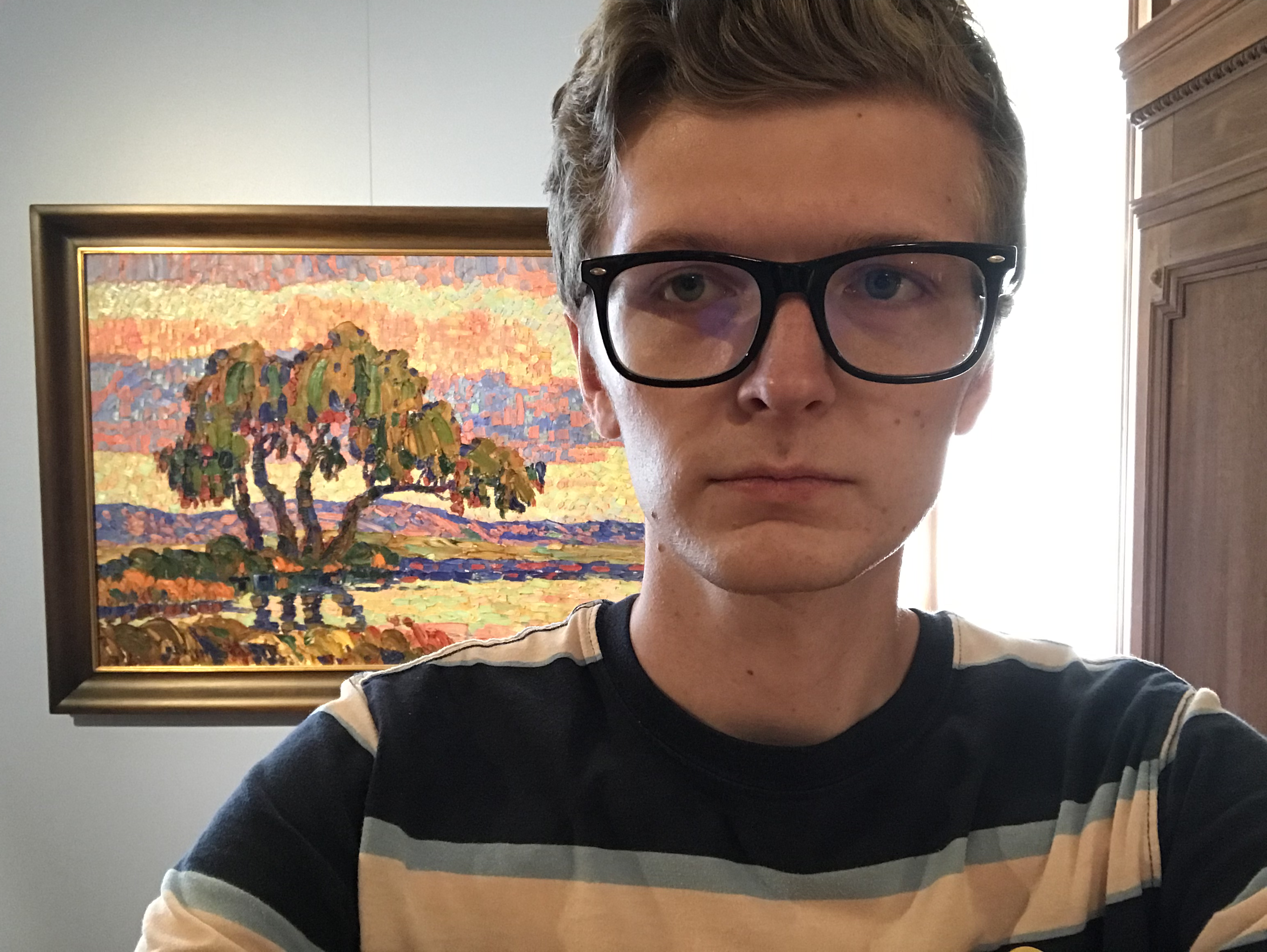
Pictured: Andrew at the American Swedish Institute in Minneapolis, Minnesota
Reflecting on his identity as a songwriter, Andrew lets us in on the early moments. “When I started, I didn't realize that's what I was doing. I was messing with an old keyboard that was lying around that I didn't really know how to use, but then it made sounds. So, I could make sounds.” Many musicians can think back to their first attempts at playing the very instruments they would end up relying on to continue their crafts. Yet not only can Andrew remember those early moments at the keyboard, but he eventually picked up the guitar, too, and soon after that began using software to learn the skills necessary for self-recording and producing. A common thread that runs through Andrew’s artistic identity and output is experimentation. He tries things that others would shy away from and he learns from them. “Not everybody makes that jump from playing guitar to recording your own things. If anything, I'd just record these ideas that weren't conventional…but experiments in random sounds.”
As time has gone by, Andrew notes that his music has transformed to incorporate balance between experimental and traditional musical structure. “Over the years, I learned to meld the experimental side with the conventional side so they became one thing.” If you listen closely to the changes from album to album in Andrew’s discography, you can notice this trend. As Andrew describes, the “discerning ear can tell over time that I have been melding those sides of myself.”
We also had a chance to talk about his songwriting process and get some insight into what it is like to compose as Andrew. “I rarely sit and write a song from start to finish in one sitting. Usually, I'll have some idea, maybe some words, but the majority of the words will come when I'm finishing the song.” For Andrew, composition involves “mashing ideas together until they form something new and interesting.” Creativity and innovation are inseparable in his description of his songwriting process, and boredom is the greatest enemy that can bare its teeth along the way. In Andrew’s work, boredom can lead to the death of a project. “If I get bored of something, I'll just forget about it.”
It is not just boredom that Andrew works to avoid, but on a related note, it’s stagnation, too. “Stagnation is something I am motivated by. It's also something I'm not particularly good at avoiding. It's still there, which is why I still write about it.” There is a tricky game to play when it comes to avoiding stagnation – it is not possible to change everything all at once. Despite his consistent effort to create something different, Andrew recognizes his own stable identity shining through over time as his albums have progressed. For example, here is part of how he describes Had Here Swung, his album released in November of last year: “With that album, I came full circle in a way. It was very similar to the first thing I ever did. I’m self-conscious about repeating myself because, from the perspective of someone who wants to do something different, you don't want to do something that's the same as something you did before.” Andrew illuminates the creative line he walks, trying to avoid stagnation in composition while also accepting that some stable identity consistently underlies his creative work.
We wrapped up our conversation by discussing SAMI itself and what the organization means to Andrew, who acts as its current Secretary. As Andrew sees it, a lot of SAMI’s value is tied to its community-building: “Community is a good way to express what you're doing without needing all of this attention. SAMI helped me have a source of accountability for what I'm working on musically without reaching for this really high goal that is only really there for a small percentage of people who are able to get there. Shooting for fame is a tricky thing for people like us because it gives the impression that you're somehow not enough until you're all the way at the top. But what we've learned over and over is that people who do reach the top are at a loss for where to go. It's wise to learn to be comfortable where you are rather than looking for some abstract future that you can't really picture. SAMI helps show that there's all kinds of people with their own sorts of vision that write songs that are unique to themselves.”
We finished our conversation as the staff at Generation NA began closing shop by focusing on the ways that SAMI has been meaningful in Andrew’s life as an individual songwriter. “SAMI, and the idea of community in general, helps me find that healthy middle ground between excessive isolation and disappearing into the shadow of other people. We do those things at different times.” These parting thoughts about SAMI’s value in Andrew’s life likely resonate with other thankful members of the organization.
Sam Bennett is a local singer-songwriter and professor at Purdue University. He hopes to continue this series with other board members before venturing into the wider SAMI community.